
Pooler City Directory Shelves
No verified, continuous Pooler-only run was found. The useful catalog is regional. Georgia Historical Society holds the broad Savannah run, the Digital Library of Georgia supplies free scans, and UGA preserves early Georgia titles. Pooler-inclusive Polk books are confirmed for several mid-century years. The two Georgia Historical Society guides disagree slightly on the endpoint of its hardcopy and microfiche run, one saying 2003 and the newer guide saying 2001, so both dates should stay attached to their source instead of being blended into a false certainty.
| Directory set | Verified span | Custodian | How to use it |
|---|---|---|---|
| Savannah regional city directories | Most years, 1848-2003 in one guide; 1848-2001 in another | Georgia Historical Society | On-site hardcopy and microfiche; many 1866-1960 books at public research stations |
| Digitized Savannah directories | Collection metadata 1871-1959; scans also found for 1961, 1962, and 1963-64 | Digital Library of Georgia, from Live Oak holdings | Free online PDFs |
| Pooler-inclusive Polk editions | 1951, 1954, 1955, 1957, 1959, 1961, 1962, 1963-64 | Digital Library of Georgia | Free online; the 1951 title expressly includes Pooler |
| Early Georgia city directories | Pre-1900, including Savannah among about 70 volumes | UGA Hargrett and MAGIL | On-site; locate each title by publisher and year |
Collection metadata is not a complete shelf list. Confirm an edition before planning a visit, and search neighboring years when one is absent. A missing volume is different from a missing person. Rural-route households, lodgers, minors, women, and new arrivals were not recorded with equal care. There is also no verified Pooler Sanborn sheet, although Georgia Historical Society has extensive Savannah fire-insurance maps.
Access also varies by custodian. Digital Library of Georgia scans can be read at home, while rare books at UGA and physical or microfiche holdings at Georgia Historical Society require the catalog and local reading-room procedures. The Pooler branch of Live Oak Public Libraries is a useful first stop for catalog help and database availability, but exact licensed products should be confirmed with staff. Before traveling, list the surname variants, target years, and suspected locality. That short worksheet lets a librarian distinguish a missing volume from a title filed under Savannah or Chatham County.
Why Pooler Uses Savannah Directories
Pooler began in 1838 as a Central of Georgia railroad stop and was known as Pooler's Station during the Civil War. Early residents may therefore be indexed under a rural Chatham district, a Savannah-oriented publication, or a railroad source. An 1885 Sholes volume places Pooler nine railroad miles from Savannah. Later books made the relationship explicit: the 1951 Polk abbreviation page defines P as Pooler, ACL as Atlantic Coast Line Railroad, and C of Ga as Central of Georgia Railway.
Search the forms “Pooler,” “Pooler's Station,” and “Pooler Station.” Add a surname and an occupation or railroad term. This broader approach is not guesswork; it follows how publishers organized the region before Pooler developed its modern city bureaucracy. For current address-based material, move to the Pooler street directory, which explains parcel and deed sources rather than historical printed books.
UGA Maps Pooler Directory Holdings
The UGA city-directories collection guide is a useful catalog doorway for Savannah and other Georgia titles. Its description explains that directories commonly arrange residents by surname and preserve street, occupation, and household details.
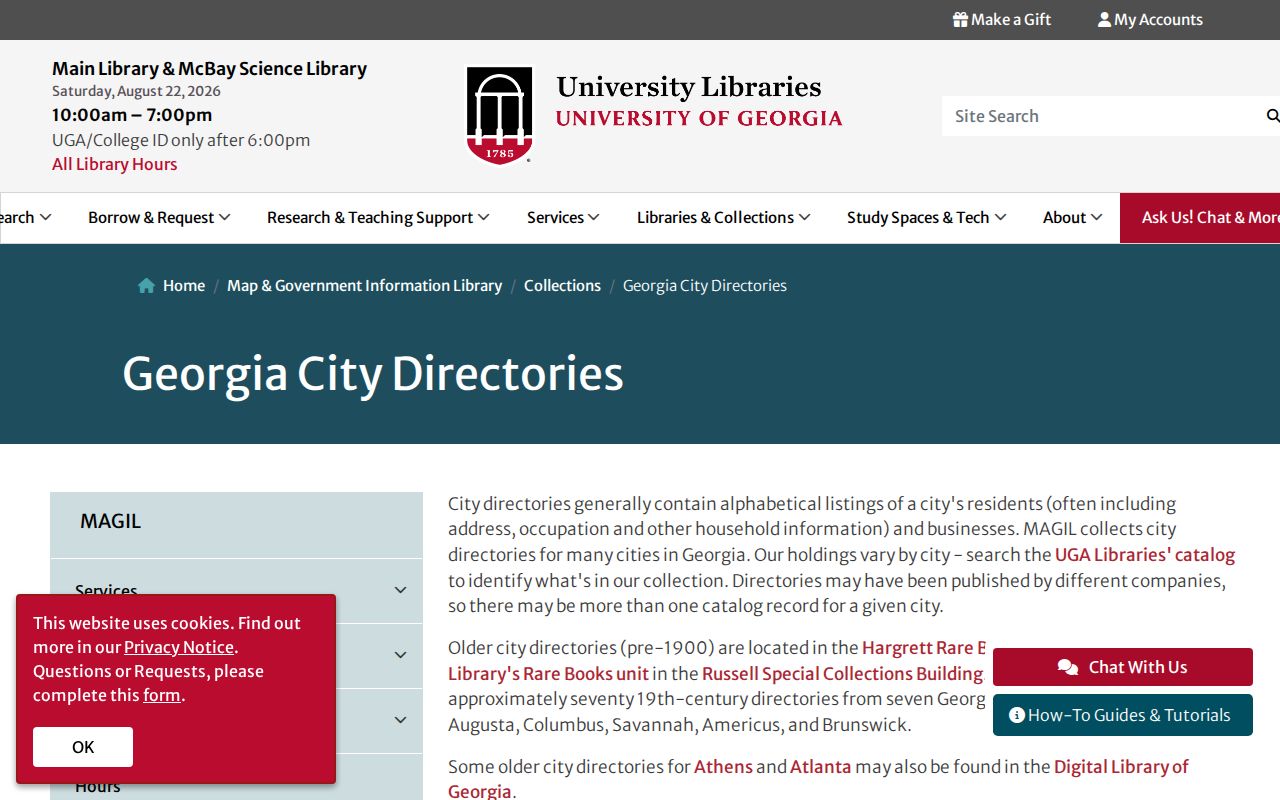
The captured UGA page helps establish where a volume belongs, but the chosen book's own title page and abbreviation key still control how an entry should be read.
Pooler City Directory Timeline
- 1848: The broad Georgia Historical Society Savannah run begins.
- 1889: The Savannah street index begins, according to the society's guide, enabling address-to-occupant work.
- 1896: Sholes' Directory was printed by The Morning News Print.
- 1938: Pettus' Savannah Directory represents another named publisher period.
- 1951: A verified Polk volume expressly includes Pooler and explains its locality and railroad abbreviations.
- 1963-64: The latest Pooler-inclusive digitized edition verified in this research.
Publishers also included A.E. Sholes, C.F. Weatherbe, W.H. Walsh, H.A. Goette, T.M. Haddock, J.H. Estill, Geo. H. Rogers, and Luke P. Pettus. Record the publisher with the year because title wording and symbols can change from one run to the next.
The street-order feature is another important milestone. Georgia Historical Society says the Savannah street index starts in 1889. In an edition that includes Pooler, that section can reverse the normal search: begin with a road or locality, then read the listed households around it. Coverage still depends on the book. Do not call every street index a complete criss-cross directory, and do not assume an unlisted rural route had no residents.
Decode a Pooler City Directory Entry
A real 1954 Pooler entry identifies Homer V, gives Mary Anna in parentheses, lists mechanical work at Hercules Powder, and ends with residence in Pooler. Another entry labels Lillian C as the widow of Lee T. These compact lines can tie people together, but the punctuation has meaning only when checked against that edition's key. Period books can also contain racial labels and segregation-era organization. Describe that structure as historical evidence without repeating dated language casually.
| Primary name | Surname usually leads in the alphabetical section; keep middle initials and suffixes. |
|---|---|
| Household cue | A spouse may be in parentheses; “wid” can name a deceased spouse. |
| Work detail | An occupation, employer, business, or work address may distinguish two people with the same name. |
| Residence | “h” or “r” may precede a street or locality; some books distinguish boarding or rooms. |
| Ownership mark | Some publishers flag owners, but never assume a symbol without consulting that volume's key. |
- Criss-cross section
- A reverse list arranged by street and number, used to move from an address to a named occupant.
- Householder index
- A list centered on the people designated as heads or principal residents, which may omit others at the same place.
- Abbreviation key
- The publisher's guide to symbols, locality codes, occupations, railroads, and residence terms. Save it with every copied entry.
Pooler Directories Bridge Census Gaps
The 1890 federal population schedules were mostly destroyed nationwide, while the 72-year confidentiality rule makes 1950 the newest public census in 2026. City directories can supply checkpoints in those blank years. Compare the 1940 or 1950 census household with the closest directory before and after it. A spouse, trade, employer, or street can help separate two residents who share a name.
For the 1890 gap, add deeds, tax records, newspapers, marriage records, cemetery indexes, and probate files. Georgia Historical Society's supporting name sources include Chatham death cards from 1803-1893, marriages from 1748-1877, and newspaper indexes across several periods. Its newspaper microfilm begins in 1763, though index gaps mean a date range may require manual browsing. A directory narrows the time and place; the original record confirms the event.
Extend Pooler Directory Clues
A street change may reflect a move, a renumbering, or simply a publisher's new wording. Match the person to a parcel or deed before treating an address string as proof. Railroad rosters and timetables are especially useful for early Pooler because the settlement grew around the Central of Georgia line. Georgia Historic Newspapers can connect a directory name to a marriage, death, civic notice, or business announcement.
For older legal material, the Chatham clerk's Garden City Records Center holds deed books, plats, maps, microfilm, and court files by appointment. FamilySearch catalogs Chatham deeds from 1785-1900 with an index extending to 1910, marriages from 1805-1902 and 1924 with an index through 1950, and Superior Court minutes from 1782-1900. Those catalog descriptions are finding aids. Cite the courthouse, archive, or scanned original when the conclusion matters.
Georgia Historical Society adds building-history sources that can explain what stood at an address. Its guide lists more than 800 cataloged maps, municipal reports from 1856-1923, title-insurance files from 1922-1979, and a Chatham property collection reaching from the 1730s into the 1920s. Savannah Sanborn maps span several editions and paste-in updates, but no Pooler-specific sheet was verified. State that limit plainly. A map of nearby Savannah is not evidence for a Pooler building unless the sheet itself covers the site.
Trace Family in Pooler City Directories
Build a year-by-year log rather than collecting isolated name hits. Transcribe each line exactly, note the book title and page, and keep the abbreviation key. This preserves small changes that can distinguish relatives from unrelated residents.
- Start with the edition nearest a known birth, marriage, death, deed, or census event.
- Check the prior and next available editions, recording changes in spouse, occupation, employer, and address.
- From 1889 onward, check the Savannah street index where available to see other listed people near the address.
- Pair the directory line with the 1940 or 1950 census and with deeds when ownership is part of the question.
- If the name vanishes, test death notices, probate, cemetery records, and a wider regional directory before concluding that the person moved.
A first appearance can bracket arrival, while a widow notation can point toward a death notice or estate file. Yet no listing proves everyone at the address was captured, and no omission proves absence. Keep spouse names, middle initials, occupations, and chronology together. That method turns a Pooler city directory entry into a strong lead without asking the book to prove more than it records.